
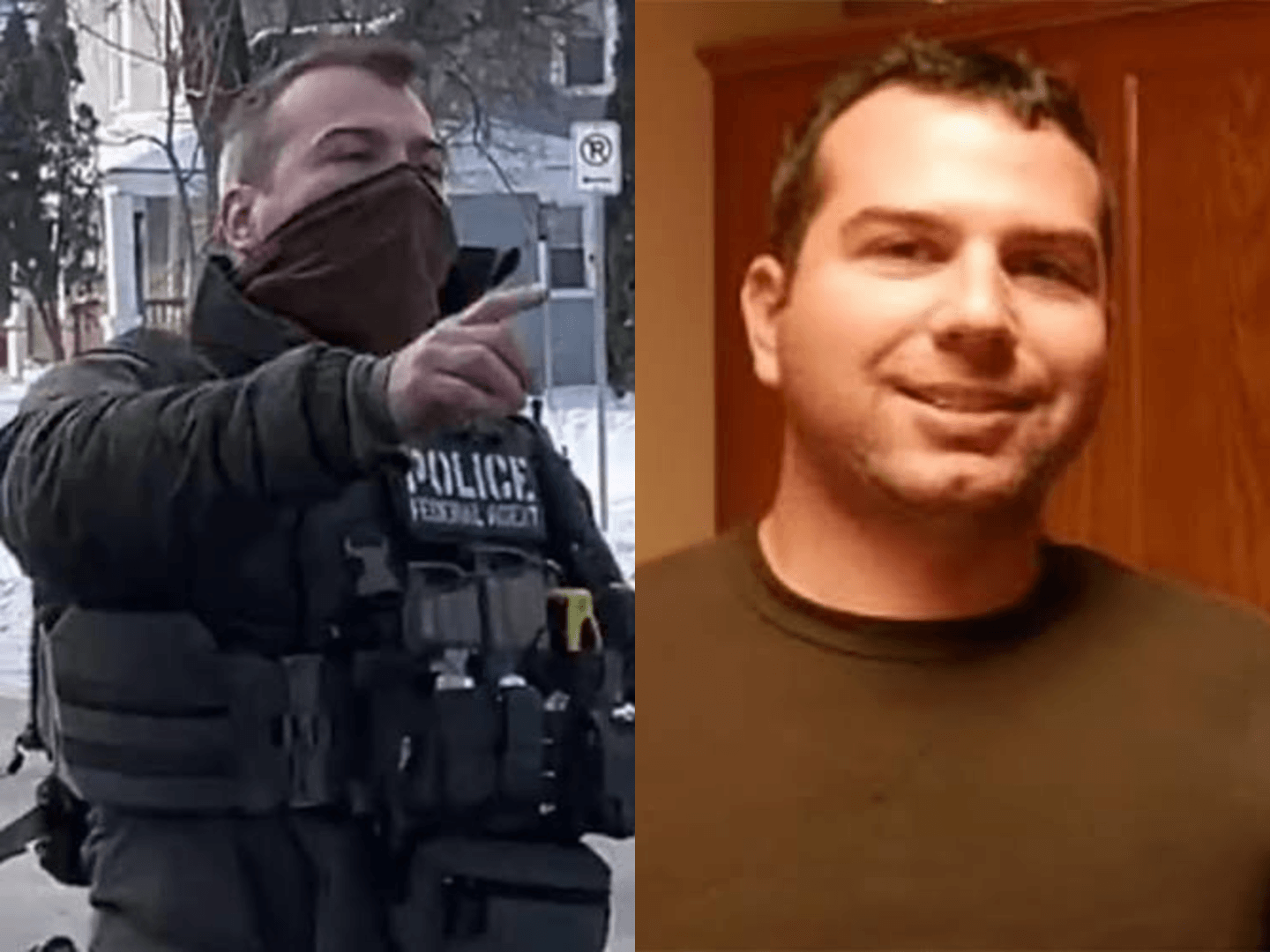
The Jonathan Ross GoFundMe is a fundraising campaign created on January 9, 2026, by Michigan resident Clyde Emmons after Ross was identified as the Immigration and Customs Enforcement agent who fatally shot Renee Nicole Good in Minneapolis. The campaign remains publicly visible on GoFundMe.
The fundraiser has attracted substantial attention because of its size, its connection to a highly contested shooting, and questions about how GoFundMe applies its rules to campaigns involving alleged violent conduct. The available evidence supports some claims clearly, while other questions remain unresolved publicly.
What Is the Jonathan Ross GoFundMe?
The official campaign is titled “ICE OFFICER Jonathan Ross,” and GoFundMe identifies Clyde Emmons as its organizer. The page lists Mount Forest, Michigan, as Emmons’ location and records the campaign’s creation date as January 9, 2026.
The fundraiser originally pursued a lower target before its goal was increased as donations accelerated. GoFundMe’s current page displays a goal of $850,000 and approximately $795,500 raised, with roughly 16,800 donations shown on the campaign.
Those figures represent the campaign’s publicly displayed fundraising total rather than proof that the same amount has been transferred to Ross. The public page identifies Emmons as organizer and states that the funds will help Ross, but it does not independently establish the final recipient or disbursement history.
The campaign description reflects Emmons’ personal position about the shooting. It says he believed Ross was justified and wanted the officer to have a GoFundMe after seeing other fundraising efforts connected with the incident. Those statements are attributable to Emmons, not independent findings.
Who Started the Fundraiser?
Clyde Emmons, rather than Jonathan Ross, created the GoFundMe campaign. GoFundMe’s public listing continues to identify Emmons as the organizer, making it important to distinguish between the person who established the campaign and the person whom the campaign says it intends to support.
Contemporary reporting also established that the campaign was not created by someone publicly identified as affiliated with Ross. Forbes reported that Emmons was not affiliated with the ICE agent when the fundraiser began and that the campaign rapidly attracted donations.
That distinction matters when assessing claims about Ross’ involvement. A fundraiser carrying someone’s name does not automatically demonstrate that the named person created it, controls it, or has already received its proceeds. Those conclusions require separate evidence about beneficiary status or fund transfers.
Why Was the Fundraiser Created?
The fundraiser emerged shortly after the January 7, 2026, shooting that killed Renee Nicole Good during an ICE operation in Minneapolis. Emmons said he created the campaign because he believed Ross deserved financial support, particularly amid other fundraising activity surrounding the incident.
The campaign became controversial partly because its early description and surrounding promotional material were interpreted as supporting possible legal expenses. WIRED reported that the fundraiser was presented as a potential legal-defense fund while GoFundMe was reviewing whether it complied with company rules.
That characterization should be handled carefully because the fundraiser’s current public description simply says the money will help Ross. The page itself does not currently provide a detailed public accounting explaining precisely how every dollar raised will be used.Jonathan Ross Quick Bio
Because reliable public records about Ross are limited, several commonly requested details, including his exact birthplace, height, current spouse, net worth, awards, and social-media accounts, cannot be verified from authoritative sources and are therefore marked accordingly.
| Field | Details |
|---|---|
| Full name | Jonathan E. Ross |
| Age | 43 years old as reported in January 2026 |
| Birthplace | Not reliably verified in authoritative sources reviewed |
| Nationality | American |
| Profession | U.S. Immigration and Customs Enforcement (ICE) deportation officer |
| Height | Not reliably verified |
| Education | Graduated from Richwoods High School in Peoria, Illinois, in 2001; later attended college. |
| Military service | Served in the Indiana National Guard and deployed to Iraq from 2004 to 2005 as a machine gunner on a gun-truck combat patrol team. |
| Years active | Approximately two decades in military and federal law enforcement; joined U.S. Border Patrol in 2007 and later worked for ICE. |
| Professional roles | ICE deportation officer, firearms instructor, active-shooter instructor, field intelligence officer and Special Response Team/SWAT member, according to his federal court testimony. |
| Awards | No reliably verified public record of specific awards located |
| Net worth | Not reliably verified |
| Spouse/partner | Not included because a current spouse or partner could not be reliably confirmed from authoritative sources |
| Social media | No verified official public social-media account identified |
Note: Ross’ professional background comes primarily from federal court testimony and established reporting based on court records. He testified that he joined the Border Patrol in 2007, worked there until 2015, and subsequently served as an ICE deportation officer in Minnesota.
What Happened to Renee Good?
Renee Nicole Good, 37, was fatally shot in Minneapolis on January 7, 2026, during an encounter involving federal immigration officers. The Minnesota Bureau of Criminal Apprehension said the FBI was leading the investigation and that Minnesota authorities lacked full access to necessary evidence.
The BCA’s January 8 statement is significant because it establishes the investigative limitations officially acknowledged by Minnesota authorities at the time. The agency said it was not conducting a full use-of-force investigation because it lacked full access to evidence, witnesses and information.
The federal and state approaches to the investigation subsequently became a major point of dispute. In July, federal authorities transferred substantial evidence to Minnesota officials, including the SUV Good was driving and federal evidence containing body-camera footage and statements from immigration enforcement agents.
The investigation remained incomplete in late July. A federal magistrate judge ordered the government to explain gaps in evidence related to personnel files, use-of-force policies, witness statements, medical records and video connected with the January 7 shooting.
What Is Known About Jonathan Ross?
The Minnesota Star Tribune identified Jonathan Ross as the ICE agent who fatally shot Good. The newspaper reported that Ross was 43 and had more than 10 years of experience with ICE, while also noting that relatively little public information was initially available about his professional background.
Court records reviewed by the Star Tribune also connected Ross to a separate 2025 incident in which he was dragged and injured by a fleeing driver during an arrest. That earlier incident is relevant background, but it does not establish what happened during the Good shooting.
The Good shooting has remained legally and politically contested. Statements from federal and Minnesota officials have differed substantially over the circumstances, while investigators have continued working through evidence surrounding the encounter and the federal government’s response to requests for that evidence.
It is therefore important not to present the organizer’s assertion that Ross was “1000 percent justified” as an established legal conclusion. The phrase appears in the fundraiser’s own description and represents Emmons’ view, rather than a judicial finding.
GoFundMe’s Review of the Campaign
The fundraiser drew scrutiny almost immediately because GoFundMe’s policies address campaigns connected to violent crimes and legal defense. On January 12, the Minnesota Star Tribune reported that a GoFundMe spokesperson said the company’s Trust & Safety team was reviewing fundraisers related to the Minneapolis shooting.
GoFundMe said at the time that its terms prohibited fundraisers raising money for the legal defense of anyone formally charged with a violent crime. The company said campaigns violating its policies could be removed, making the review particularly relevant because Ross had not been publicly charged at that point.
The campaign nevertheless remained online. As of August 19, 2026, the official GoFundMe page continues to display the fundraiser, its donation total and its option to contribute, providing direct evidence that the campaign has not been removed from the public platform.
GoFundMe also publicly describes its Trust & Safety process as involving reviews intended to prevent misuse and protect the platform’s integrity. Its transparency materials say users can report fundraisers for suspected misuse or violations of its Terms of Service.
Bill Ackman’s $10,000 Donation
One of the campaign’s most notable donors was investor Bill Ackman, who contributed $10,000. The donation received significant media attention because Ackman publicly discussed his reasoning and later made a comparable donation connected to the family of another person killed during federal immigration enforcement activity.
Ackman explained his Ross donation by citing the legal principle that a person is innocent until proven guilty. The Star Tribune reported that he also said he wanted to support a GoFundMe for Good’s family, but that campaign had already closed when he attempted to donate.
Ackman’s contribution became part of the broader public debate surrounding the campaign. His involvement did not establish Ross’ legal position or determine how the shooting would ultimately be evaluated, but it helped bring additional attention to a fundraiser already attracting hundreds of thousands of dollars.
How Much Has the Campaign Raised?
The campaign’s fundraising total has changed over time as donations have arrived. GoFundMe currently displays approximately $795,539 raised toward an $850,000 goal, alongside roughly 16,800 donations, making it one of the most substantial publicly visible fundraisers connected with the January shooting.
Earlier reporting illustrates how quickly the campaign grew. On January 13, Forbes reported that the fundraiser had surpassed $630,000 only four days after its creation, while the Star Tribune later reported that it had exceeded $790,000 by January 27.
The campaign’s rapid growth contrasts with the uncertainty surrounding its eventual financial destination. A public fundraising total is not equivalent to a verified payment to a beneficiary, so the displayed figure should not be described as money already deposited into Ross’ personal account without additional evidence.
Does Jonathan Ross Receive the Money?
The public GoFundMe page says the funds “will go to help him,” but the available campaign information does not provide a complete public accounting of transfers, withdrawals or expenditures. GoFundMe identifies Emmons as organizer, which does not by itself establish who ultimately receives the money.
A separate GoFundMe campaign created by another organizer explicitly identifies its own organizer as beneficiary and explains how its funds will be used. That comparison demonstrates why organizer status alone should not be treated as proof of beneficiary status, especially when discussing a campaign involving a public controversy.
Claims that Ross personally received the entire amount raised therefore require caution. The trustworthy sources reviewed for this article establish the campaign’s public fundraising total and organizer, but they do not provide sufficient evidence to state that Ross personally received or controlled all of those funds.
What Is Known About Ross’ Legal Status?
The available authoritative material does not establish a criminal conviction against Ross for Good’s death. Minnesota’s BCA said the FBI was leading the investigation, while later reporting documented continuing disputes over access to evidence and the completeness of material provided to Minnesota officials.
The distinction between an investigation and a criminal conviction is essential when describing the fundraiser. Calling someone convicted, indicted or formally charged requires specific court or prosecutorial records establishing that status, rather than relying on campaign language, political statements or social-media claims.
The July evidence dispute also shows why the factual picture should not be treated as permanently settled. A federal magistrate judge found that the government had not fully complied with an evidence-transfer order and required an explanation for missing or incomplete materials.
What the Fundraiser Does and Does Not Establish
The fundraiser establishes that supporters created a substantial public campaign around Jonathan Ross following the January shooting. It also demonstrates that Emmons publicly supported Ross and that thousands of donors contributed, with the campaign approaching its $850,000 target.
The campaign does not, by itself, establish that Ross was legally justified in the shooting. That statement originates with Emmons, while official investigations and evidence reviews have continued independently. Treating the fundraiser’s description as a legal determination would confuse advocacy with verified findings.
Likewise, the campaign’s public total does not prove that Ross received the money. Without authoritative documentation showing a transfer or beneficiary arrangement, the most defensible description is that approximately $795,500 has been raised through the publicly visible campaign.
Why the Jonathan Ross GoFundMe Continues to Attract Attention
The campaign remains notable because it combines crowdfunding, law-enforcement controversy and an unresolved investigation into a fatal shooting. Its nearly $800,000 total also illustrates how quickly online fundraising can mobilize supporters around disputed events before every investigative question has been resolved.
GoFundMe’s continued hosting of the campaign adds another layer to the story. The company publicly acknowledged a Trust & Safety review in January, yet the campaign remains accessible months later, leaving the public with a visible fundraising page but limited information about its internal review or financial administration.
For readers trying to understand the story, the most reliable approach is to separate campaign claims from independently verified facts. The organizer’s statements explain why supporters were asked to donate, while government records and established reporting provide the stronger basis for describing the shooting and subsequent investigation.
Conclusion
The Jonathan Ross GoFundMe is a genuine campaign organized by Clyde Emmons on January 9, 2026, following the fatal shooting of Renee Nicole Good in Minneapolis. GoFundMe currently shows approximately $795,500 raised toward an $850,000 goal from about 16,800 donations.
The fundraiser’s significance extends beyond its financial total. It became a highly visible expression of support for Ross while the circumstances of Good’s death remained contested and investigative authorities continued dealing with evidence-access disputes. Those circumstances explain much of the campaign’s continuing public interest.
The strongest verified conclusion is straightforward: the campaign exists, Emmons organized it, thousands of people donated, and GoFundMe continues to display it publicly. What cannot responsibly be claimed from the available evidence is that Ross personally received the entire fundraising total or that the campaign’s characterization of the shooting constitutes a final legal finding.FAQs
Who started the Jonathan Ross GoFundMe?
Clyde Emmons created the Jonathan Ross GoFundMe on January 9, 2026. GoFundMe lists Emmons as the campaign organizer, not Jonathan Ross.
How much has the Jonathan Ross GoFundMe raised?
The GoFundMe campaign has publicly displayed approximately $795,500 raised toward an $850,000 goal, with about 16,800 donations. These figures can change as additional donations are made.
Did Bill Ackman donate to the Jonathan Ross GoFundMe?
Yes. Investor Bill Ackman donated $10,000 to the campaign. He publicly explained that his decision was connected to the principle that people are innocent until proven guilty.
Has GoFundMe removed the Jonathan Ross fundraiser?
No. GoFundMe reviewed the campaign after concerns were raised about its purpose, but the fundraiser remains publicly accessible on the platform as of August 19, 2026.
Does Jonathan Ross personally receive the GoFundMe money?
That has not been established by reliable public evidence. The campaign says the funds will help Ross, but the publicly available page does not provide sufficient information to confirm how much money, if any, has been transferred directly to him.
